
Why “Clean and Charged” Heat Pumps Still Underperform
Why “Clean and Charged” Heat Pumps Still Underperform - by Anthony Keys
The hidden oil film nobody checks
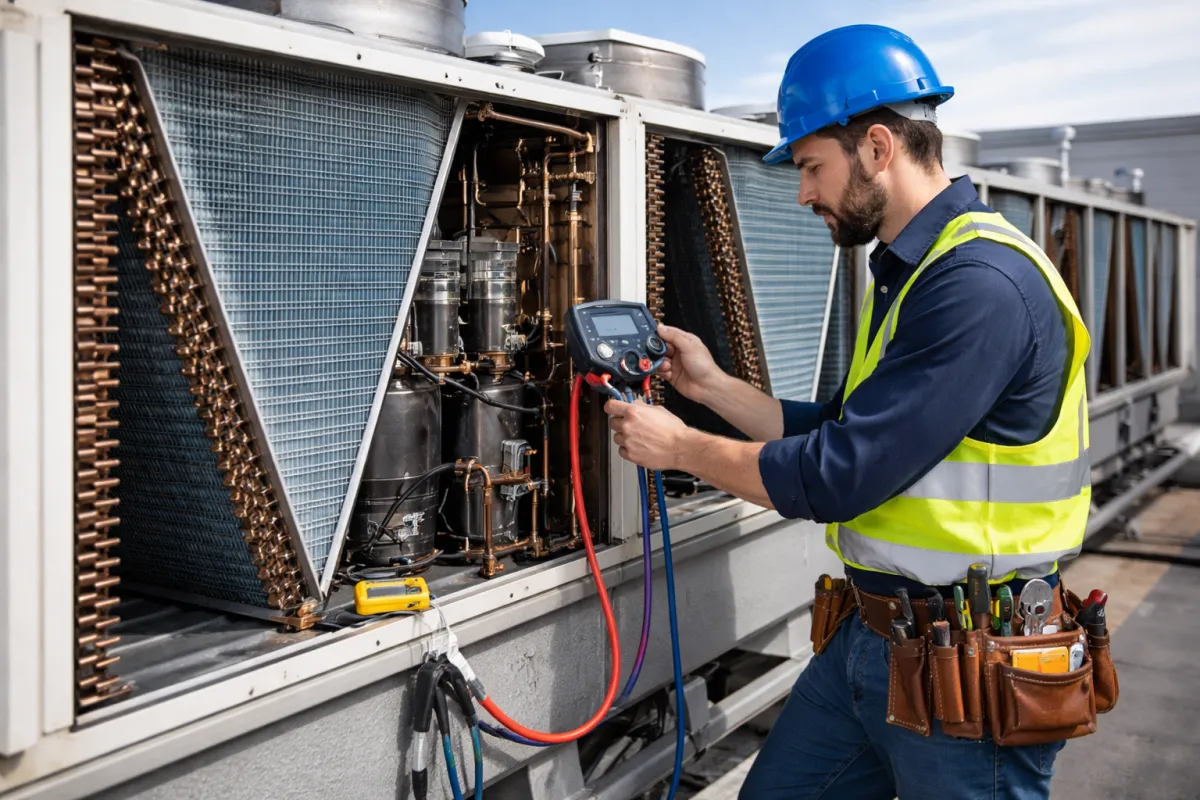
If you have a heat pump not cooling correctly, you are likely dealing with a hidden mechanical issue. Most HVAC owners have seen this movie. A heat pump is less than two years old. The coil has been cleaned. Airflow is correct. Refrigerant charge checks out.
And yet the system still:
Struggles to hit the setpoint
Runs longer than it should
Shows elevated head pressure
Delivers weak Delta-T
The tech leaves frustrated. The homeowner is still uncomfortable. And the company gets blamed. At that point, most shops start pointing fingers: “These new systems are junk.” “Microchannel coils don’t last.” “It’s probably the ductwork.”
Sometimes those things are true. But very often, something else is happening. Something you cannot see.
The Hidden Cause of HVAC Performance Loss: Internal Oil Fouling
Every refrigeration system carries oil. That oil is supposed to lubricate the compressor, but it also moves with the refrigerant. Over time, a portion of that oil does not return. It sticks to the internal metal surfaces of the evaporator and condenser.
Not dirt. Not dust. Oil.
That oil forms a thin, invisible film on the inside of the tubing and microchannels. And oil is a thermal insulator. Even if the coil is spotless on the outside, the metal on the inside is wrapped in a heat-blocking layer.
Why a Heat Pump is Not Cooling Even When it Looks “Normal
An oil-coated heat exchanger can still hold pressure, circulate refrigerant, and pass leak tests. But heat transfer is degraded. When heat cannot move through the coil walls efficiently:
Superheat becomes unstable
Head pressure rises
Compressor amps increase
Capacity drops
The system has to run longer and harder just to keep up. From the outside, it looks like it just “never quite works right.” From the inside, it is simple physics.
Why Air-Side Coil Cleaning Can’t Fix a Performance Gap
Traditional maintenance only touches the air side: coil cleaner, rinse, and fin combs. That cleans dirt off the fins, but it does nothing to the oil bonded to the internal metal where the refrigerant actually flows.
The refrigerant never leaves the system. The oil never leaves the system. So the fouling stays. You can wash the outside of a dirty window all day; if there is a film on the inside, the light still does not get through.
The Hidden Business Cost of Poor Heat Transfer
Oil fouling is not just a performance problem. It is a profit problem. It causes:
More callbacks
Lower close rates
More “nothing fixed” service visits
Bad online reviews for “brand new” systems
Your techs get blamed for problems they cannot solve with tools they were never given.
How ACFlush Corrects Heat Pump Underperformance
Oil fouling requires an internal solution. That is what ACFlush is designed to do. It is a specialized chemistry used in mission-critical facilities that:
Enters the sealed system.
Breaks the bond between oil and metal.
Displaces the fouled oil and returns it to the compressor.
The metal becomes exposed again. Heat transfer is restored. Delta-T improves. Pressures normalize. Run time drops. And the system behaves like it should have in the first place.
If you want to see it for yourself
Oil fouling is real. And once you know it exists, you start seeing it everywhere.
If you want to see what internal coil restoration looks like in the field—before and after—let’s talk. I’m not here to sell you; I’m here to show you a documented mechanical correction that protects your customers and your margins.
Not to be sold.
To be shown.